Level up how your business operates.
AI has changed what small and mid-sized businesses can build. We start with an audit, modernize the foundation, automate repeatable work, and add AI only where it creates real value.
Start with a workflow map; leave with a phased modernization and automation roadmap.
Request an auditThe window is open. It will not stay open forever.
AI is changing the economics of business software. A small business can now build focused systems that were once reserved for companies with much larger technology budgets—with AI and the right partner.
That creates a time-bound opportunity: move early, build useful capabilities, and give your business room to learn before the market catches up.
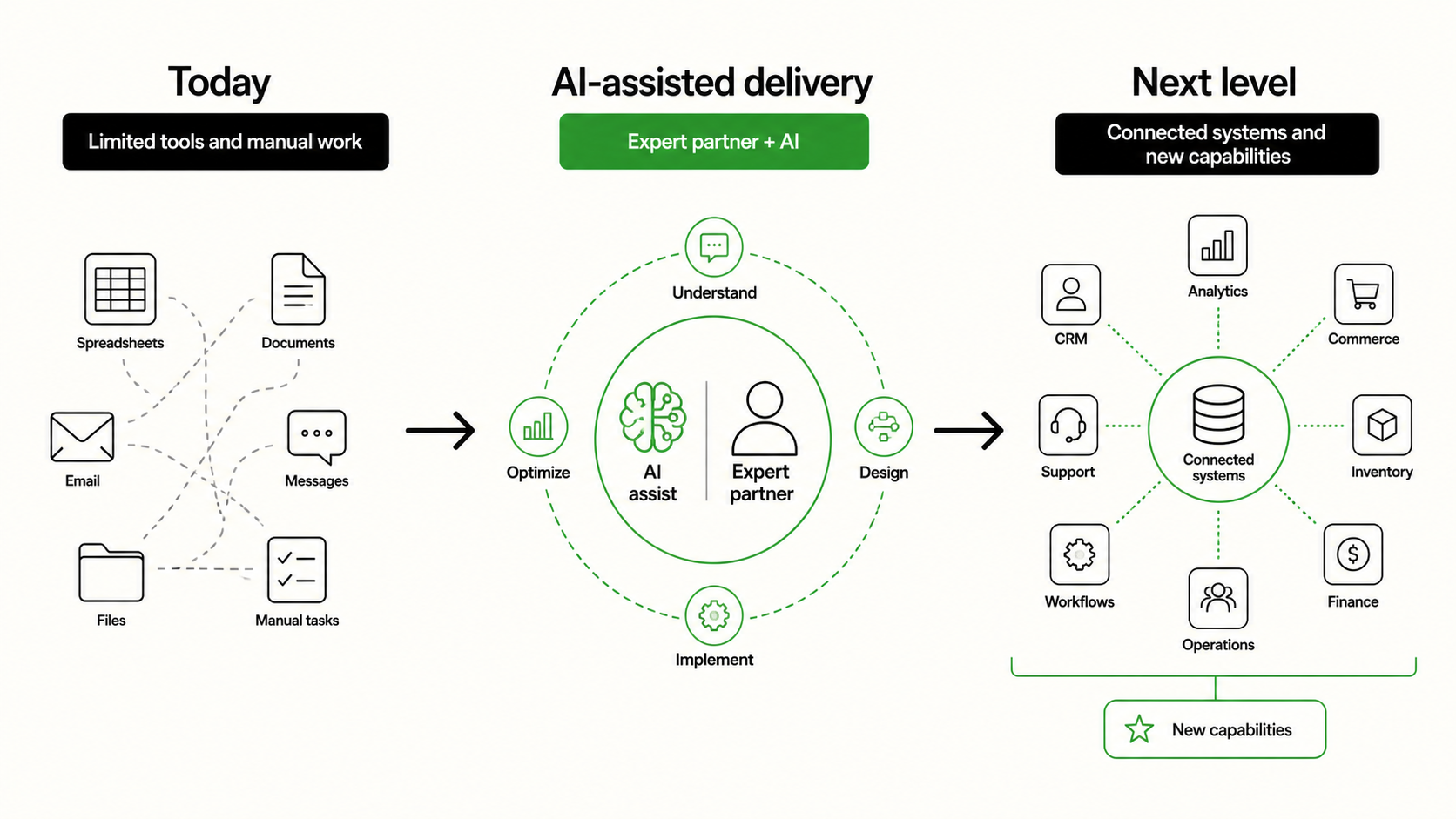
Move before the market catches up
Whatever your sector, there is work that can be made more productive when the right information and tools are connected. Move now, or give your competitors the chance to move first.
Let early learning compound
Early adopters can capture more of the upside by applying AI to real work, learning what fits, and improving while others are still watching.
Choose the partner carefully
The technology changes quickly. Look for practical expertise, reliable delivery, a clear point of view, and enough proximity to understand your business.
Technology alone is not a strategy. You need a partner who can understand the work, make sound trade-offs, deliver reliably, and stay close enough to help the system improve with your business.
See the work clearly before you change it.
An audit is the starting point. We map where information lives, how work moves, and where time is lost—then put a practical modernization and automation roadmap in front of the operators who can act on it.
After the audit, you see a workflow map that is often the first shared view of how the operation really runs, with time boxes attached to each process and the person responsible for it. It makes clear where time is spent, where it is wasted, and why a focused investment in automation can pay off quickly.
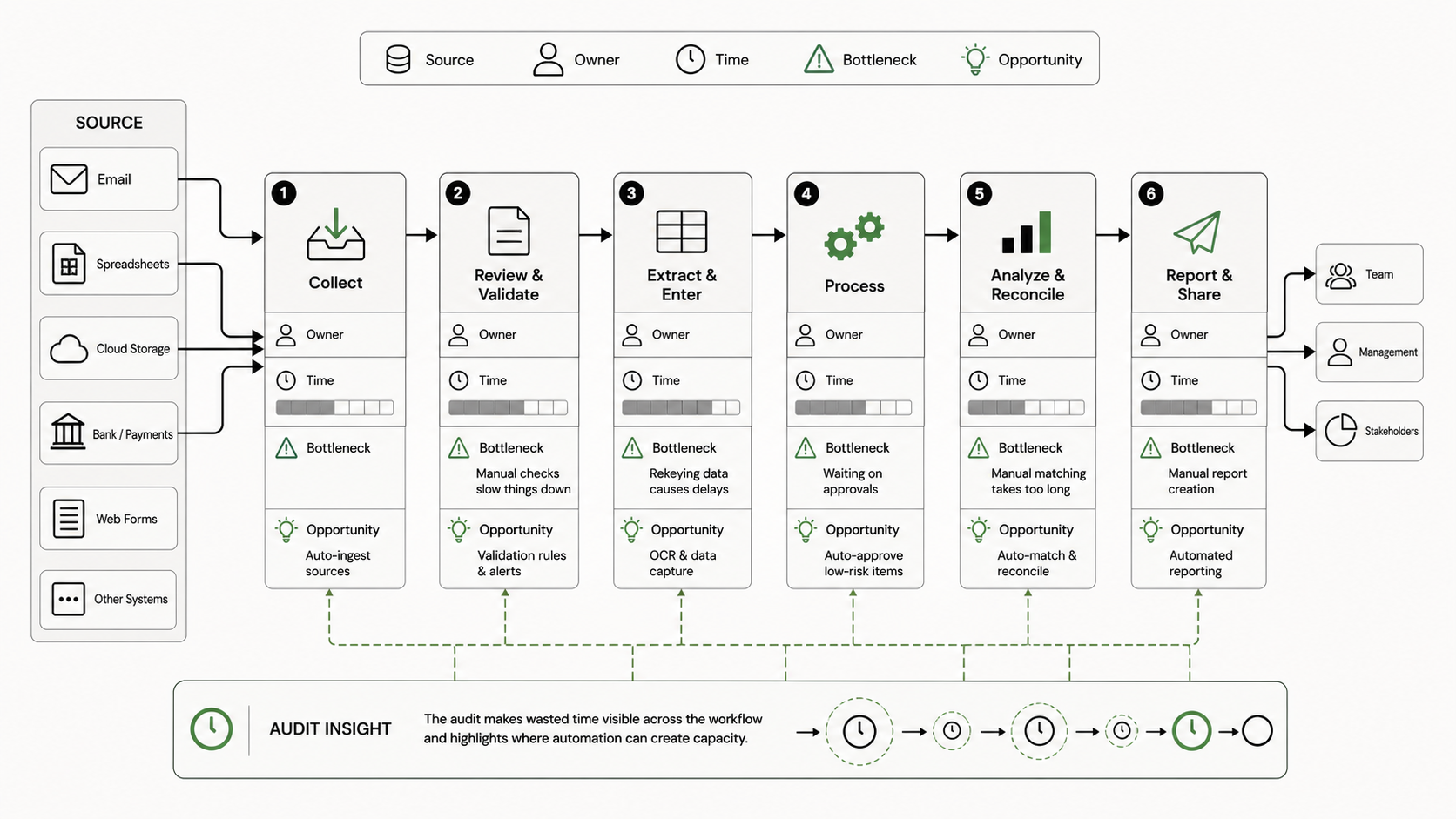
Map the current operation
Talk with the people who do the work and inventory the systems, spreadsheets, email, CMS, and handoffs they rely on.
Quantify what is worth changing
Attach the hours spent by each process owner to the map so priorities, waste, and potential savings are visible.
Plan the next phase
Leave with a phased roadmap: what to modernize, what to automate, where people decide, and where AI may help.
An audit turns a vague AI ambition into a plan you can act on.
The roadmap may have been out of reach before. The audit is how you make it concrete.
Make the business intelligence dependable before you add more intelligence.
Many AI requests are really modernization needs. If information is scattered across email, spreadsheets, CMS records, and duplicated systems, the first job is to make the sources, workflows, and ownership clear enough to trust.
Connect the source of truth
Bring the information the work depends on into a clear, reviewable view instead of asking people to search and reconcile it by hand.
Make the workflow explicit
Document the handoffs, rules, and exceptions so repeatable work can be automated and unusual work can reach the right person.
Make time and ownership visible
Attach each step to an owner and a time cost so operators can prioritize changes and see whether they are helping.
Use intelligence where the work needs it.
AI should earn its place in the workflow. Once the foundation is dependable, choose the simplest approach that can be trusted—and add AI when interpretation, synthesis, or adaptation is the part that slows the work.
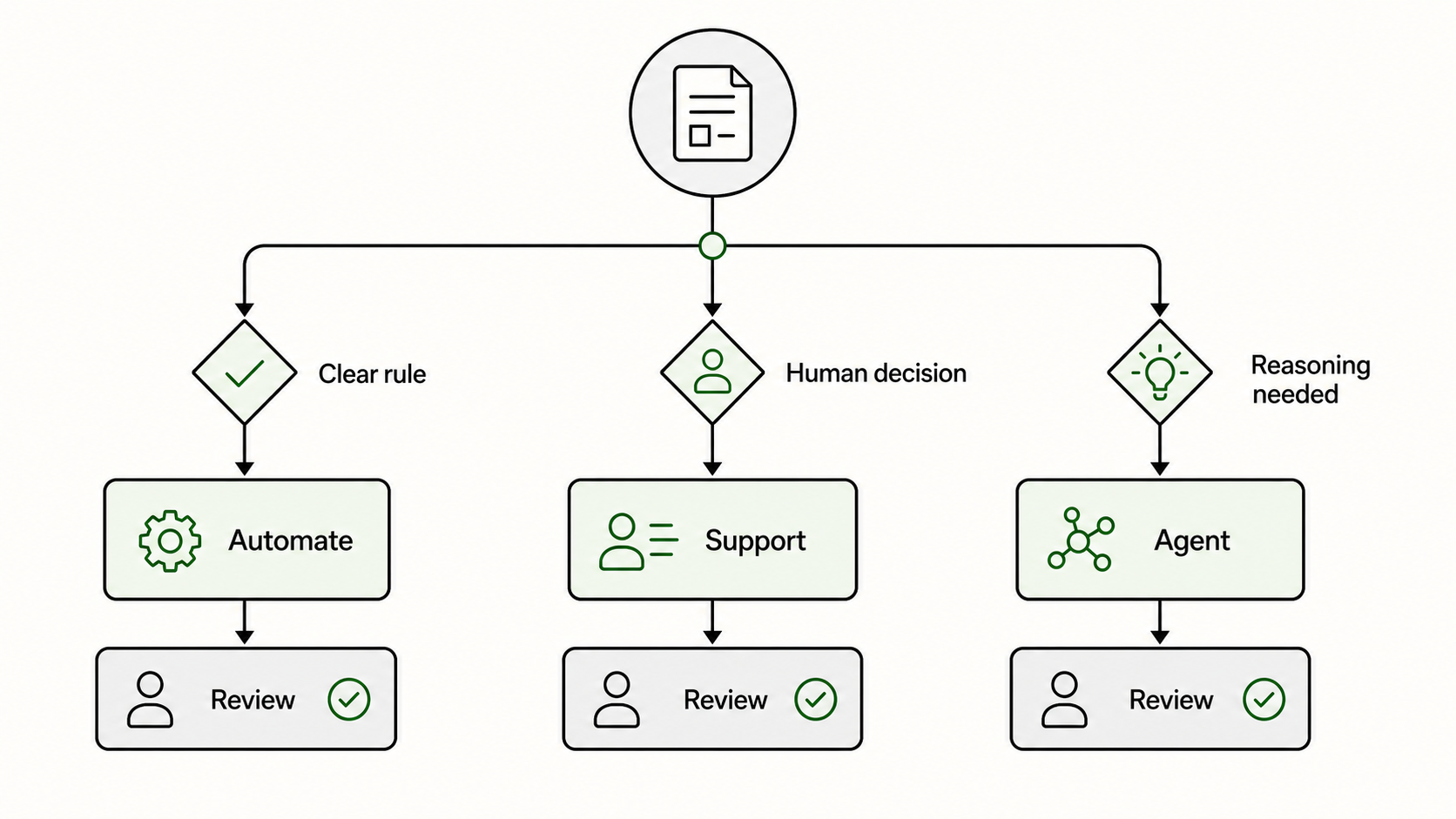
Make AI a capability your people can use responsibly.
AI adoption is not a software rollout. Leaders need a view of where it belongs, teams need practice on real work, and everyone needs clear boundaries for privacy, review, and accountability.
Give leaders a clear starting point
Help CXOs decide which priorities deserve attention, what to measure, and where AI should not be used.
Practice on work that matters
Use real workflows—not toy prompts—to show how AI can help with research, drafting, analysis, and handoffs.
Build habits that hold
Teach people to check outputs, protect sensitive information, and keep ownership of decisions.
Turn the opportunity into a plan.
Map one workflow, quantify the time involved, and leave with a phased modernization and automation roadmap.
- 01 Workflow and decision map
- 02 Data and integration readiness assessment
- 03 Risk, evaluation, and human-review requirements
- 04 Prioritized next step with scope boundaries