Make AI useful in the work your people already do.
Practical workshops for executives and teams. Learn the fundamentals, try them on real work, and set sensible boundaries for using AI.
Learn the tools. Improve a real task. Keep judgment with people.
Discuss a training programTurn curiosity into a way of working.
A workshop is a working session, not a product demo. People learn the basics, apply them to a task they know, and leave with a clearer view of where AI belongs.
Understand the fundamentals
See what current AI tools are good at, where they are unreliable, and how better context leads to better results.
Improve a real workflow
Work with familiar tasks such as research, drafting, analysis, or handoffs. Separate useful assistance from work that still needs a person.
Spot bounded opportunities
Identify work with a clear purpose, reliable inputs, a review point, and someone accountable for the outcome.
Learn by working through the tasks that matter.
The content is practical and adapted to the people in the room, so the lessons can travel back into everyday work.
Practical AI fundamentals
Ask better questions, provide useful context, assess an answer, and recognize when a tool is guessing.
Workflow opportunities
Map where people read, compare, draft, summarize, and hand work from one person to another. Decide which steps need help and which need judgment.
Bounded use
Give each experiment a clear task, limited access, a way to check the result, and a named owner.
Leaders set direction. Teams make it real.
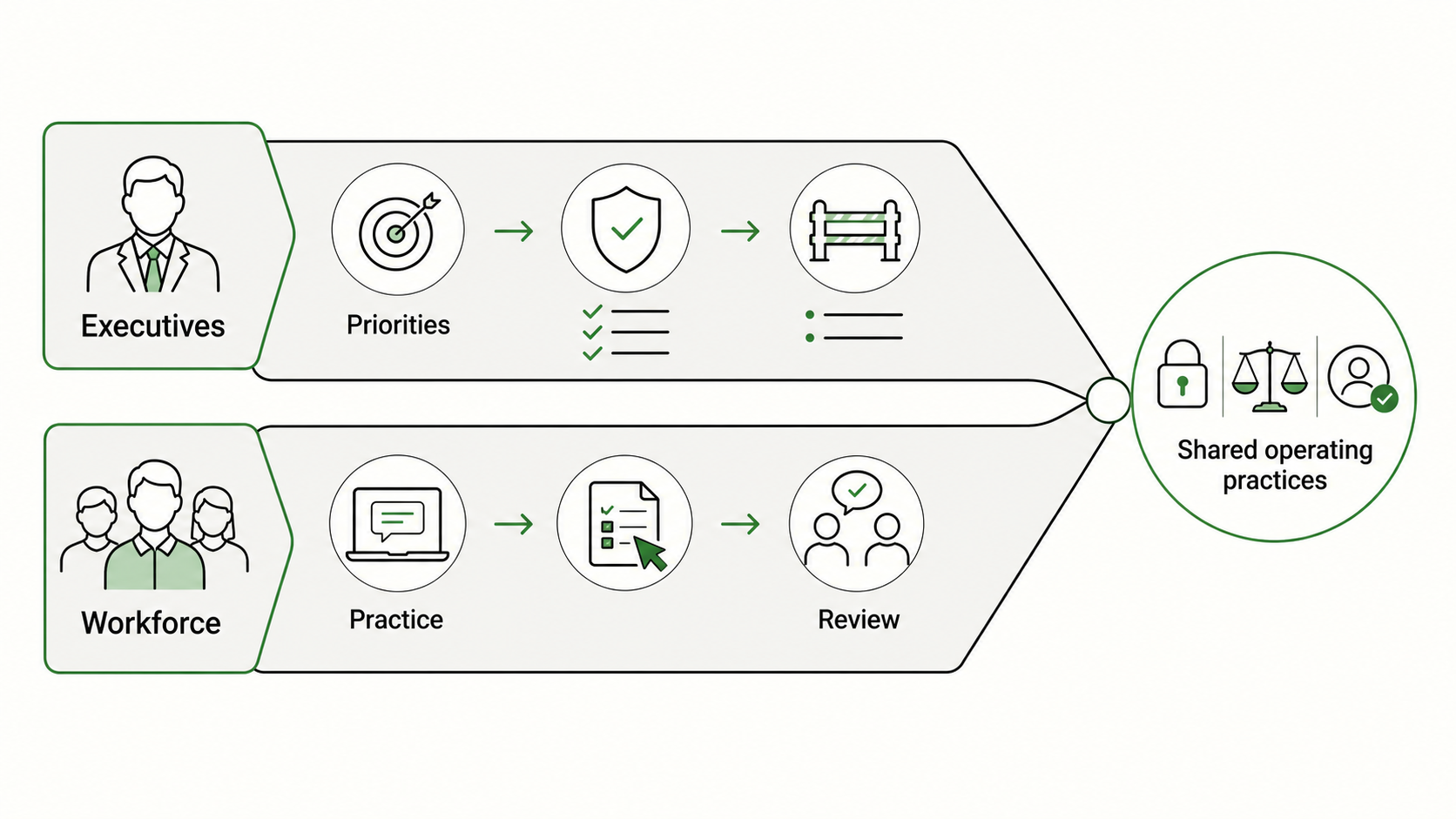
Executives and the workforce need different conversations, but they should leave with the same expectations for care, review, and ownership.
For executives
Decide where AI belongs in the operating agenda, which opportunities deserve attention, and who owns the risks.
For the workforce
Practice using AI on everyday tasks, checking outputs, and protecting private business information.
For the organization
Agree on a simple standard for review, privacy, accountability, and continued learning.
Bring the work. Leave with usable practice.
The session stays close to the organization’s actual tasks, language, and constraints.
- 01
Before the session
Bring the people who do the work, a few representative tasks, and any boundaries the group needs to respect.
- 02
In the session
Learn the basics, try the tools on those tasks, compare the results, and discuss where human judgment remains essential.
- 03
After the session
Leave with examples the team can reuse, clear boundaries for further practice, and a shortlist of opportunities worth examining.
Use AI with judgment, not autopilot.
Good training makes responsibility visible. It helps people move faster without pretending that every answer is safe to accept.
Protect private information
Know what can be shared with a tool, what must stay inside the business, and when to ask before using a new service.
Check the output
Compare important answers with a trusted source and treat confident-sounding mistakes as possible.
Keep ownership visible
A person remains responsible for the decision, the customer impact, and the process that follows.
Give your people a practical way to use AI well.
Tell us who should attend and which work you want to improve. We’ll shape a workshop around the people, tasks, and boundaries that matter to your organization.
Discuss a training program