Rebuild the systems your business runs on.
Many requests for AI transformation are really requests for better systems. We rebuild the data, workflows, and tools underneath the business, then add automation or AI only where it improves the work.
Focused scope. AI-assisted delivery. Expert review.
Request an auditThe problem may not be a lack of AI.
If the business cannot reliably find, move, or trust its own information, adding a model will not repair the foundation. The first opportunity is often classic IT modernization.
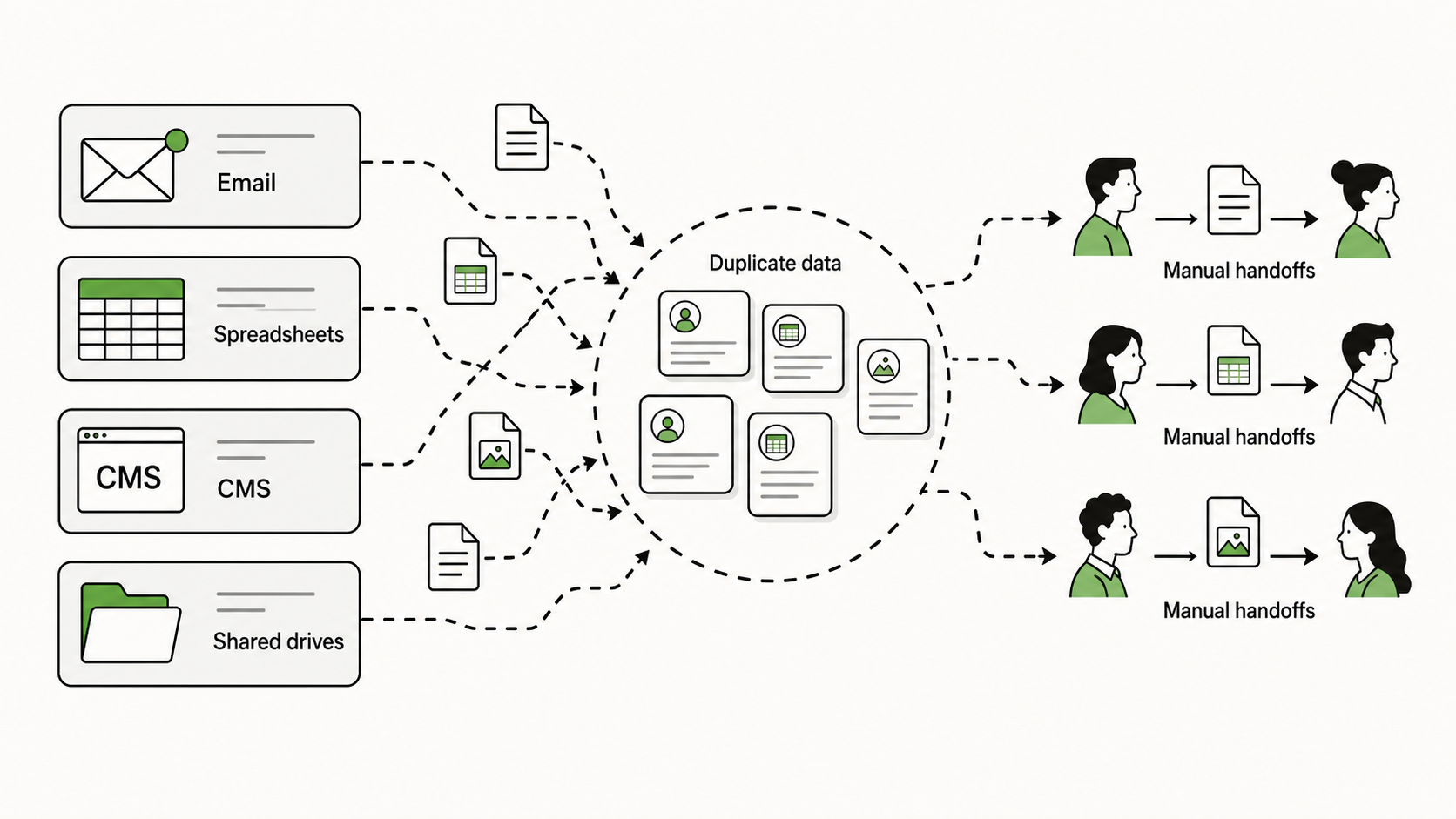
Knowledge is scattered
Critical information lives across email, spreadsheets, a CMS, shared drives, and individual memory.
The same work happens repeatedly
People copy, reconcile, reformat, and re-enter information because systems do not share it cleanly.
Operators do not trust the data
Duplicate records and conflicting sources turn basic reporting into a manual investigation.
Handoffs depend on memory
The workflow works because experienced people remember what to check, who to ask, and what happens next.
Rebuild business intelligence from the source.
Business intelligence starts with reliable information and a clear flow of work—not a new dashboard or model. We rebuild the layers operators depend on, in the order they depend on them.
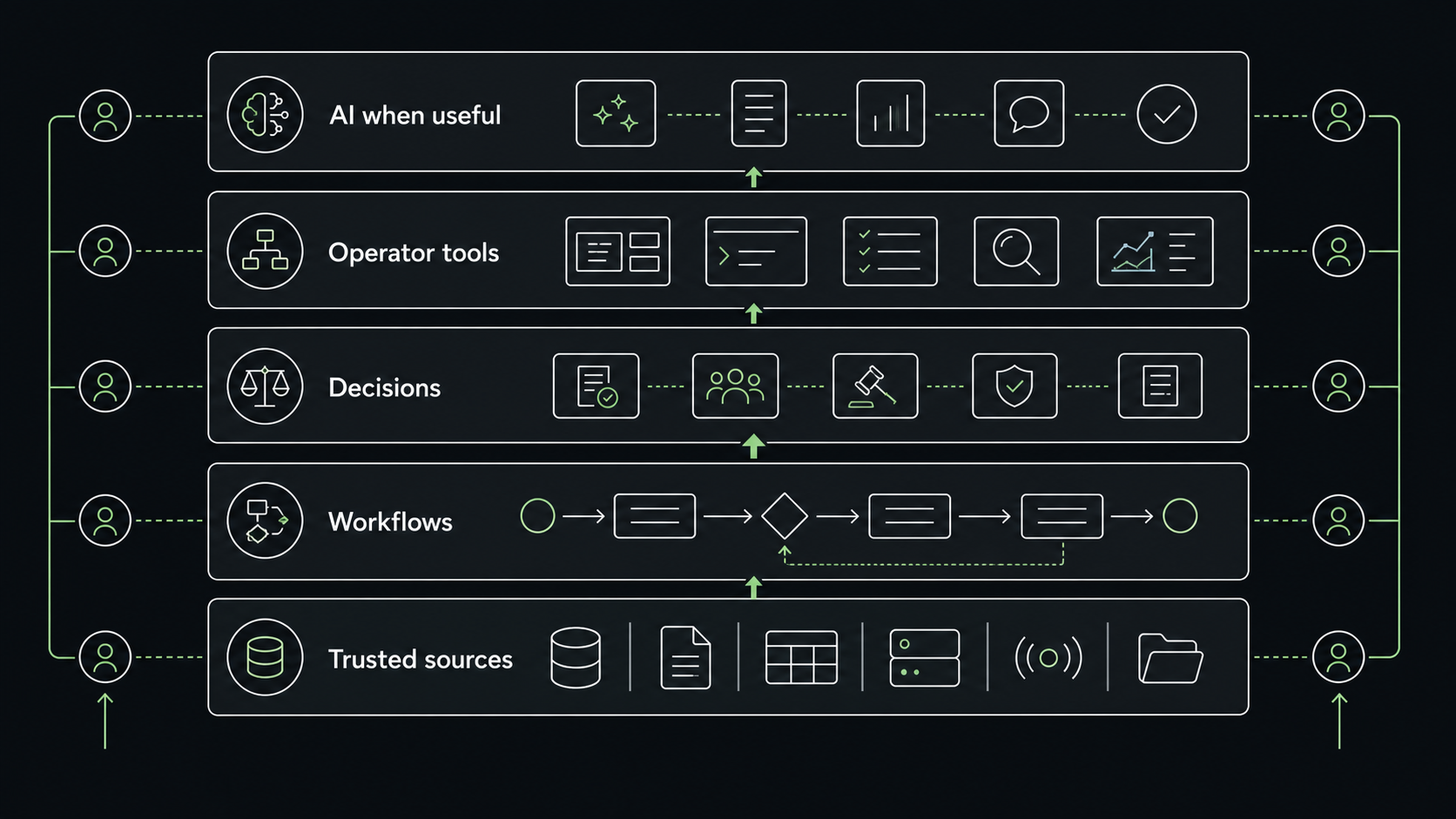
Sources
Identify the authoritative records, remove duplication, and connect the information the workflow needs.
Reliable inputsWorkflow
Make the steps, rules, handoffs, and common exceptions explicit instead of leaving them in people’s heads.
Visible operationsDecisions
Show who decides, what context they need, and where responsibility must remain with a person.
Clear accountabilityTools
Give operators a practical interface for finding information, completing work, and reviewing outcomes.
Usable systemsA dependable operating foundation that people can trust, automation can use, and AI can build on.
Use the simplest approach that solves each part of the workflow.
The goal is not maximum AI. It is a system that works. Each step should use rules, human judgment, or agent reasoning according to what the work actually requires.
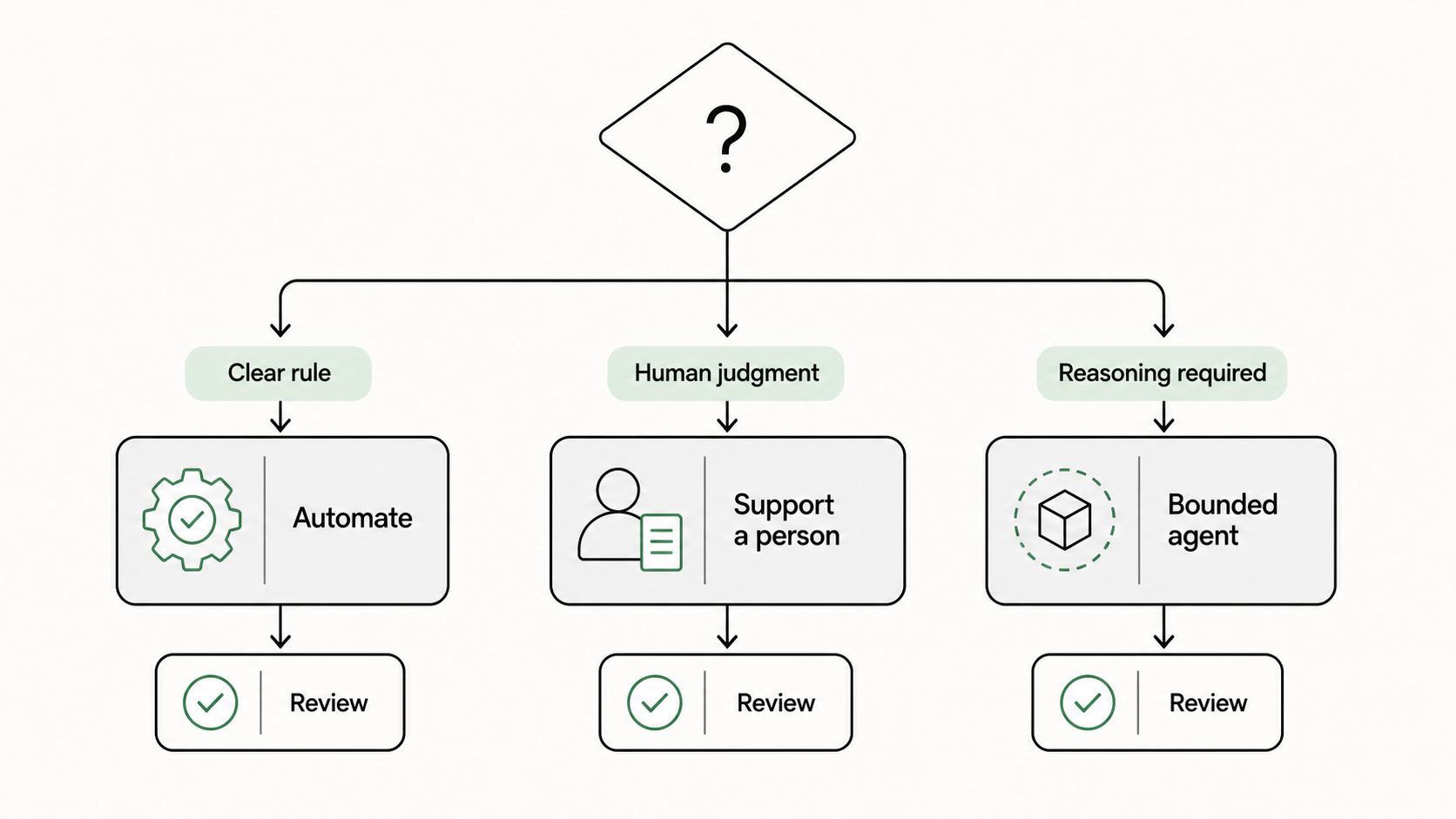
Simple automation
When the rule is clearUse deterministic steps for validation, calculations, routing, notifications, and repeatable handoffs.
Human decision
When judgment remains accountablePrepare the records, history, and exceptions so the responsible person can make a better-informed decision.
Agent reasoning
When interpretation is requiredGive an agent a bounded task, reliable inputs, explicit permissions, and a clear human review point.
Modernization no longer needs to be an open-ended program.
We use AI throughout research, migration, code, testing, and documentation. Experienced people still make the architecture decisions, review the work, and remain accountable for what ships.
- 01
Audit and scope
Map the workflow, sources, owners, time costs, and constraints. Choose a bounded first phase with a clear outcome.
- 02
Build and migrate
Connect reliable sources, replace duplicate work, and rebuild the tools around the agreed workflow.
- 03
Test with operators
Run normal cases and exceptions with the people who use the system before it becomes part of daily work.
- 04
Hand over and expand
Document the system, train its owners, and use what was learned to prioritize the next phase.
Focused phases can be measured in weeks, with scope, owners, and acceptance criteria agreed before the build begins.
Find out what should be modernized first.
Map one workflow, attach time and ownership to every step, and leave with a phased modernization and automation roadmap.
- 01 Workflow and decision map
- 02 Data and integration readiness assessment
- 03 Risk, evaluation, and human-review requirements
- 04 Prioritized next step with scope boundaries